Comparison · updated 28 August 2026
Gaggia E24 vs Breville Bambino
Buy the Gaggia if you want the machine to stop being the limit on how good your coffee gets, and you accept that everything else is now your job. Buy the Bambino if you want espresso on a weekday morning without a project attached. These are not two rungs on a ladder. One is built to commercial fittings and does nothing for you; the other heats in seconds and does most of the small things for you. The $149.05 between them is the least interesting fact on this page.
One naming note first. Amazon sells the Gaggia as the RI9380/46 E24, but the listing’s own Model Name field reads Gaggia Classic Evo Pro. If you came here having read about a Classic Pro, this is the same listing.
The 58 mm fitting is the difference that never goes away
Every other difference between these machines is something you get used to. This one compounds. 58 mm is the commercial standard — the size a café machine uses, and therefore the size the accessory industry tools up for. Bottomless portafilters, precision baskets in specific dose weights, calibrated tampers, distribution tools, puck screens, replacement gaskets and shower screens are made in 58 mm by dozens of companies. Buying the E24 buys you into that market on day one, whether or not you ever use it.
The Bambino is 54 mm, Breville’s size across its entire range. That is not a fringe fitting — 54 mm baskets and tampers are easy to find, and Breville supplies single-wall and dual-wall baskets in the box. It is simply a smaller world, stocked for Breville owners rather than for cafés.
Two machines on this site take a 58 mm portafilter. One is the E24. The other is the Breville Oracle Touch (BES990) at $2300.95, which rates 3.4 stars across 597 Amazon reviews — the lowest rating in the entire set. That is the whole field. There is no third option and no cheaper one.
Be honest about whether you will use any of it. Most people who buy an espresso machine never buy a second basket. If that is you, read the rest of this page as though the portafilter row did not exist.
Three seconds is the difference you feel every morning
The Bambino’s listing names ThermoJet heating and claims optimum extraction temperature in three seconds. That is Breville’s figure, not a measurement of ours — we do not test machines — but it is also the spec Bambino owners raise unprompted in the review corpus. The same listing claims PID temperature regulation and low pressure pre-infusion.
The E24’s listing names no heating system at all. It uses the word “boiler” once, inside a sentence about a component that better resists scale, and never says which kind. So we are not printing one. That absence is itself the finding: heating decides how long you wait, how stable the shot is, and whether you can brew straight after steaming, and it is the spec this category is least willing to publish. What the E24 does state is 1200 watts against the Bambino’s 1560 — 360 watts fewer. Wattage is not performance, but it bounds how fast a cold machine can put heat into water, and nothing on that listing suggests a fast-heating design.
Nor does the E24 offer temperature control, a display, a shot timer or a programmed volume; its listing describes the entire human interface as “buttons”. The Bambino has one-cup and two-cup buttons that stop the shot once you have set them. Convenience or crutch is a matter of taste. That it changes how the machine behaves is not.
The spec sheet, and the two gaps in it
| Spec | Gaggia E24 (RI9380/46) | Breville Bambino (BES450) |
|---|---|---|
| Price (snapshot) | $449.00 | $299.95 |
| Heating | Not stated by the listing | ThermoJet |
| Portafilter | 58 mm | 54 mm |
| Built-in grinder | No | No |
| Milk | Manual steam wand | Automatic steam wandSteam wand — listing's spec field says “Manual”, its own bullets say automatic |
| Power | 1200 W | 1560 W |
| Water tank | Not stated | Not stated |
| Advertised pressure | 9 bar | Not stated |
| Amazon rating | 4.4★ (3,169) | 4.0★ (2,598) |
The milk row cannot be trusted, and we are not going to pretend otherwise. The Bambino’s listing contradicts itself: its structured Special Feature field reads “Manual”, while its own feature bullets sell an automatic steam wand that adjusts milk temperature and texture. Both are on the same page. Until that is resolved we will not build a recommendation on which wand the Bambino actually ships with. The E24’s listing is unambiguous by comparison — a commercial steam wand, manual, with latte art among its recommended uses.
Neither tank size is printable. The E24’s structured Capacity field says “2.1 liters” and the Bambino’s says “47 fluid ounces”. Both look sensible. The same field returns “1 cups” and “4 pounds” elsewhere in this category, and a plausible number in a demonstrably broken field is not evidence.
One row that is not in the table and should be. The Bambino’s listing states a one-year manufacturer warranty, in a structured field and again in its feature bullets. The E24’s listing states no warranty length at all — the field is simply absent. Both carry Amazon’s free 30-day refund window, and both listings were read on the same day. Put that next to a durability topic whose summary names failures at around eighteen months and it turns into something you can act on: find out what warranty the seller offers before you pay, because the failure pattern arrives long after the 30-day window closes.
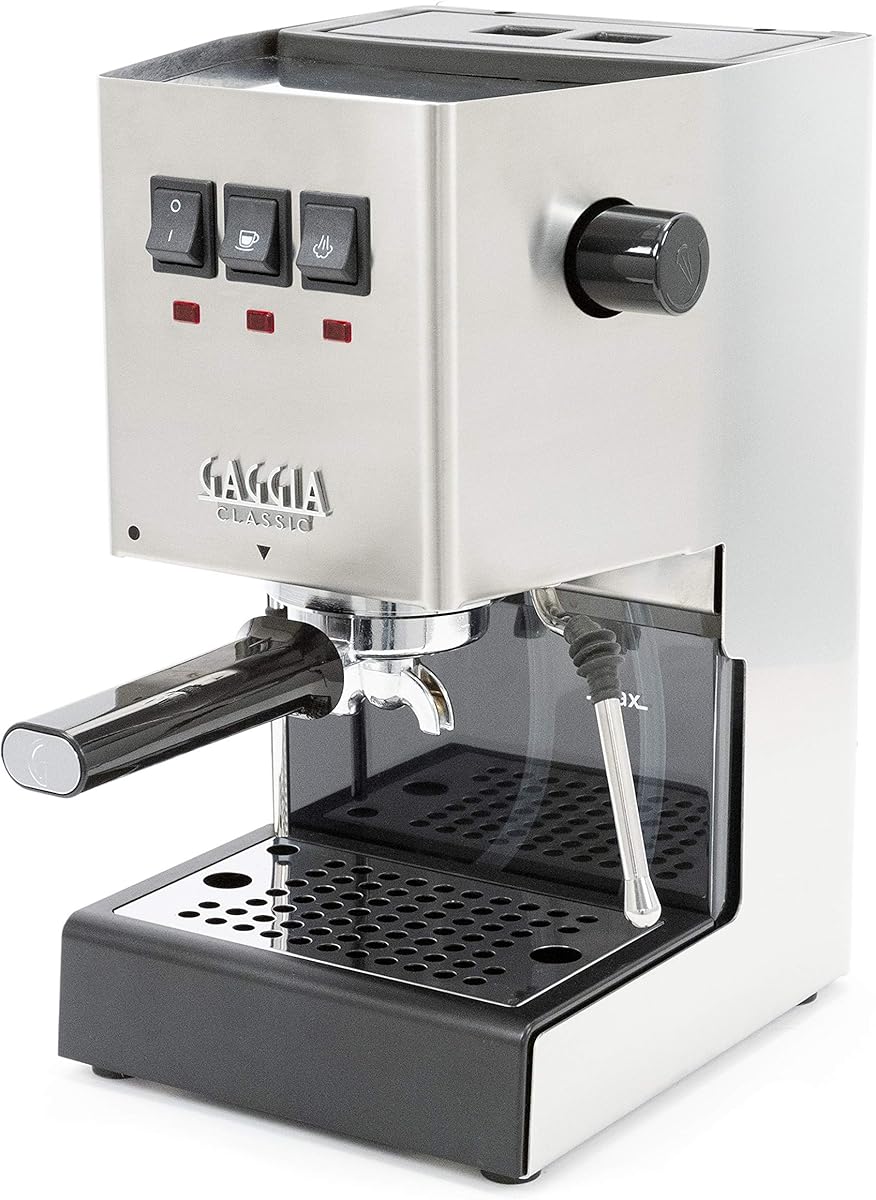
Gaggia E24 (RI9380/46)
58 mm commercial portafilter, a three-way solenoid valve, and 9 bar quoted at the puck rather than at the pump. Two commercial baskets and a pressurised one in the box, so you can start easy and move over.
$449.00 · 3,169 reviews
What buyers report, side by side
Amazon groups review mentions into topics on both listings. Below are those topics, with every total computed as positive plus negative rather than read from the listing’s own total field — that field abbreviates large counts and reports them as single digits elsewhere in this category. Neither corpus is flattering in the same place, and neither machine gets a free pass here.
- Praised: Performance is the largest topic on the listing: 363 positive mentions against 75, for a computed total of 438.
- Praised: Espresso quality runs 189 positive against 25 — 12% negative across 214 mentions, the cleanest topic in its corpus. — owners of a working one like what comes out of the cup
- Mixed: Value for money is openly split: 142 positive against 64, 31% negative.
- Complaint: Durability is negative on balance — 47 positive against 77, 62% negative — and Amazon's own topic summary names breakdowns at around a year and a half.
- Complaint: Leakage runs 4 positive against 58: 94% negative across 62 mentions, described as water spitting and a steam wand that drips. — the most one-sided topic in any corpus on this site, in either direction
Amazon's own review-topic aggregation on this listing, read 29 August 2026 — how many mentions it groups under each topic and which way they lean. Not quotes from individual reviews, not gathered by us, and not from testing we do not do. Every total is computed as positive + negative.
- Praised: Espresso quality is the largest positive cluster: 168 positive against 31, 199 mentions in total.
- Praised: Ease of use draws 130 positive against 33, with milk steaming named repeatedly as the easy part. — the opposite of what the E24's corpus talks about
- Praised: Compact size runs 61 positive against 9 — 13% negative, usually about the machine fitting a counter nothing else would.
- Mixed: Reliability splits almost evenly: 124 positive against 112 across 236 mentions.
- Complaint: Durability is the corpus's clear problem — 17 positive against 80, 82% negative, with failures inside the first few months a recurring pattern. — this is where the 4.0 rating comes from
The same aggregation on the Bambino's listing, read the same day and stated the same way — positive + negative, never the listing's own total field.
Read those two blocks together and the shape of the decision changes. The E24’s worst topic is leakage at 94% negative across 62 mentions — water spitting, a wand that drips. That is the most one-sided topic in any corpus on this site, in either direction, and it is not a compliment. The Bambino’s worst topic is durability at 82% negative, with failures inside the first few months rather than at eighteen. Its reliability topic splits nearly evenly across 236 mentions, which is exactly what a 4.0-star average hides: this is not a uniformly mediocre machine, it is a machine some people get a bad one of.
The E24 rates 4.4 across 3,169 reviews against the Bambino’s 4.0 across 2,598. That gap is real and we are not explaining it away. It is not evidence that the E24 is the more reliable object: both corpora name a hardware failure pattern as their single worst topic. They fail differently, on different timescales.
Volume runs the other way. The Bambino’s listing badges roughly 2,000 bought in the past month against the E24’s 500 — about 4× — and sits at #4 in Amazon’s Semi-Automatic Espresso Machines rank against the E24’s #12, both read the same day. That is which machine the market defaults to, not which one suits you.
The counter, where the obvious answer is wrong
The Bambino is 6.3 inches wide, the narrowest Breville on this site, and that number does most of its marketing. It is also, on the counter, the larger of these two machines. The E24 is deep and narrow where the Bambino is long and thin, and depth × width is the honest way to compare them because these listings do not label their two horizontal edges consistently.
Worked example
Counter area for a working setup, not for the machine alone
Listing dimensions read 28 August 2026, multiplied as depth × width. Neither machine has a grinder, so neither rig is complete without one; the Breville Smart Grinder Pro (BCG820) stands in because it is the only grinder this site covers, not because we know what either machine's owners buy.
- 1Gaggia E24 (RI9380/46) alone8 × 9.5 in, 14.2 in tall, 20 lb.76 in²
- 2Breville Bambino (BES450) alone13.7 × 6.3 in, 12 in tall, 10.9 lb.86 in²
- 3A grinder — the Smart Grinder Pro (BCG820) here — which both of them need8.46 × 6.28 in, and 15.33 in tall — taller than either machine.53 in²
- 4E24 plus grinderThe complete rig, as it will actually sit on your counter.129 in²
- 5Bambino plus grinder10 in² more than the E24 rig, not less.139 in²
The compact machine is not the smaller setup, and it was never going to be. Once the grinder is on the counter — and it has to be, for both — the E24 rig is the tighter of the two by 10 square inches. The Bambino wins on width and on weight (10.9 lb against 20, a factor of 1.8), and it is 2.2 inches shorter, which matters under a low wall cabinet until you notice the grinder is taller than either of them.
Where the Bambino genuinely wins on space is that its two objects need not sit together. A grinder can live in a cupboard and come out twice a day. If your real problem is one specific narrow gap, that flexibility beats the square inches.
Neither machine grinds anything, so the money arithmetic lands identically on both and there is no point running it twice. We have set out what a machine-plus-grinder setup actually costs, and why a blade grinder is not a cheaper version of the purchase, on the Bambino’s own review. Add roughly the same grinder budget to whichever machine you pick; it does not break the tie, because it is the same on both sides.
Two tools, because neither machine will do this for you
Both of these are here for the same reason: no grinder, on either machine. The first week with either one is spent discovering that the machine is not the variable — the grind is. Neither the E24 nor the Bambino has an opinion about it, and neither will tell you which way to move.
Shot ran wrong — finer or coarser?
Runs in your browser. Nothing is sent anywhere.
Water is finding channels through the puck faster than it can dissolve the coffee — the shot will taste thin and sour.
The basket selector maps to something real on both. The E24’s listing itemises a commercial single, a commercial double and a pressurised double, with a tamper and scoop. The Bambino’s itemises one-cup and two-cup baskets in single-wall and dual-wall, plus a milk jug, tamper, wand cleaning tool and descaling powder. A pressurised or dual-wall basket manufactures crema from almost any coffee and caps how good the shot can get; the single-wall and commercial ones remove that cap and hand you the responsibility. Both boxes let you start forgiving and move over.
The second tool is about the part of the shot you control on both. The Bambino’s two buttons stop the shot at a volume you set; the E24 stops when you stop it. Either way the ratio between the dry coffee going in and the liquid coming out is your decision, and it changes the cup more than the difference between these two machines does.
Brew ratio and flow rate
Runs in your browser. Nothing is sent anywhere.

Breville Bambino (BES450)
ThermoJet heating with a three-second claim, PID temperature regulation, 6.3 in wide, and two preset shot buttons. Its listing states a one-year manufacturer warranty; the E24's states none.
$299.95 · 2,598 reviews
What each one gives up
The E24 gives up speed, feedback and any stated heating system. No display, no timer, no programmed volume, no temperature setting, the lowest wattage of any machine here that publishes one, and a manufacturer that will not name how it heats water. It also gives up the warranty statement, and leakage is a named pattern in its corpus rather than an outlier.
The Bambino gives up the fitting, and clarity about its own milk system. 54 mm is a smaller accessory world, permanently. Its listing cannot agree with itself about whether the steam wand is manual or automatic. Its durability topic is 82% negative and its 4.0-star average is the lowest of the two by a clear margin.
Both give up the grinder, which is the largest thing either of them gives up and the one buyers most reliably forget to budget for.
Who should buy neither of these
If you want one box and no second purchase. A machine with the grinder inside it removes the entire counter-and-budget argument above. The built-in versus separate grinder comparison is the page for that decision, and it applies to the E24 just as squarely — the E24 plus a grinder lands close to what a Barista Express costs on its own.
If you are not sure you will still be doing this in a year. Find out cheaply first. The $120 option against the Bambino is an honest way to test whether you enjoy the process before spending four times as much on fittings you may never use.
If milk is the whole reason you are buying. Neither of these textures milk for you in a way we are willing to vouch for — the E24’s wand is manual and the Bambino’s listing disagrees with itself. The Bambino against the Bambino Plus is where automatic milk is argued properly, because the Plus’s listing states it without contradiction.
The one question that decides it
Do you want to get better at this, or do you want coffee? Most people know their answer immediately. If it is the first, the E24 is the only machine under $2,000 that will not become the ceiling — the full E24 review goes through what that costs you in convenience and in leaks. If it is the second, the Bambino is faster, lighter, narrower and better at getting out of your way, and the full Bambino review is honest about the 4.0 stars behind it. Buying the wrong one because it was the more expensive one is the mistake this page exists to prevent.
Grow into it
Live with it
Prices, ratings and review counts are Amazon’s, read 28 August 2026, and change without notice. We do not test machines and do not claim to. How this page was put together is set out in our editorial policy.