Machine review · updated 28 August 2026
Gaggia E24 review
Buy the E24 if you expect to still be making espresso in five years and you want the machine to stop being the limit on how good it gets. Skip it if you want the machine to do any of the work for you, because it does almost none. It has no grinder, no display, no programmed shot volume and nothing that adjusts a temperature on your behalf. What it has instead is a 58 mm commercial portafilter, and that single fitting decides more about the next five years than any feature on this page.
One naming note before anything else, because it sends people to the wrong page. Amazon sells this as the Gaggia RI9380/46 E24, but the listing’s own structured Model Name field reads Gaggia Classic Evo Pro, and the product description uses that name throughout. If you arrived looking for a Gaggia Classic Pro review, this is the machine that listing is selling. We are calling it the E24 because that is what is printed on the buy button.
The 58 mm portafilter is the entire argument
58 mm is the commercial standard. It is the size a café machine uses, which means it is the size the accessory industry builds for. Bottomless portafilters, precision baskets, calibrated tampers, distribution tools, puck screens, replacement gaskets and shower screens are all made in 58 mm by dozens of manufacturers, because that is where the volume is. None of that is Gaggia’s doing. Gaggia simply built to the fitting everyone else already builds to, and you inherit the whole market as a result.
Look at what the alternatives inherit. Breville’s machines on this site are 54 mm — every one of them except the $2300.95 Oracle Touch (BES990), which is also 58 mm and costs five times as much. The CASABREWS CM5418 is 51 mm, a size that is neither of the other two. Accessories exist for 54 mm and, more thinly, for 51 mm. They exist in a different order of quantity for 58 mm.
The E24 is the only machine covered here under $2,000 with that fitting. That is not a marketing line; it is what the specification table below shows, and it is the reason this page exists.
The area figure matters more than it looks. A wider basket spreads the same dose of coffee into a shallower bed, and a shallower bed is more forgiving of an imperfect tamp and less prone to the water carving a channel straight through it. This is a modest effect, not a transformation, and it will not rescue a bad grind. It is worth one sentence, and it has now had it.
It advertises 9 bar, and that is the more useful number
The E24’s listing files “9 bar” in a structured spec field labelled Output Pressure, and puts “9 Bar Espresso Extractions” in its feature bullets. The CM5418 files “20 bar” in the identically-named field. Same field, two completely different kinds of claim.
Espresso is extracted at about 9 bar. That is the target, not a ceiling and not a compromise. A 20 bar figure describes what a pump can generate at full effort against a closed valve, with no coffee in the path — a specification of the part, not of your coffee. Gaggia is quoting the pressure at the puck. CASABREWS is quoting the pressure at the pump. The bigger number is the less informative one, and we have taken that apart properly on the CM5418’s own page. Every Breville here, incidentally, publishes no bar figure at all.
The feature list names a commercial three-way solenoid valve, which is the component that dumps the pressure left in the group head into the drip tray the moment the shot ends. The practical consequence is a puck that knocks out dry instead of collapsing into sludge. It is a small mechanical courtesy and it is the sort of thing that only ever appears on machines built to commercial fittings.
The spec sheet, and what is missing from it
| Spec | Gaggia E24 (RI9380/46) | CASABREWS CM5418 Compact | Breville Bambino (BES450) |
|---|---|---|---|
| Price (snapshot) | $449.00 | $119.99 | $299.95 |
| Heating | Not stated by the listing | Not stated by the listing | ThermoJet |
| Portafilter | 58 mm | 51 mm | 54 mm |
| Built-in grinder | No | No | No |
| Milk | Manual steam wand | Manual steam wandSteam wand, per the listing's feature text | Automatic steam wandSteam wand — listing's spec field says “Manual”, its own bullets say automatic |
| Power | 1200 W | 1350 W | 1560 W |
| Water tank | Not stated | 34 oz | Not stated |
| Advertised pressure | 9 bar | 20 bar | Not stated |
| Amazon rating | 4.4★ (3,169) | 4.3★ (8,114) | 4.0★ (2,598) |
The heating row is the honest embarrassment of this category. None of these three listings names a heating system. The E24’s uses the word “boiler” exactly once, inside a sentence about an updated component that better resists scale and corrosion, and never says which kind. That is not enough to print as a spec, so we have not. Heating is the single most consequential thing about a home espresso machine — it decides how fast you can start, how stable the shot is, and whether you can brew straight after steaming — and most of the market will not tell you.
The water tank is the same story from the other direction. The listing’s structured Capacity field reads “2.1 liters”, which is a plausible number, and we are still not going to print it. That field returns “2.1 pounds” for the CASABREWS and “1 cups” for the Barista Express (BES870XL). A field that unreliable does not become reliable because this time the answer looks sensible.
What the listing does state cleanly: 1200 watts, a brushed stainless housing described as “Solid Steel Housing, Made in Italy”, 20 pounds, and 8 by 9.5 inches of counter — about 76 square inches, which is actually less than the 86 a Bambino occupies, because the E24 is deep-and-narrow where the Bambino is long. It is 1.8× the Bambino’s weight in that smaller area. The listing also files “Self Serviceable” among its special features, which is a real and unusual thing for a manufacturer to advertise.
1200 watts is the lowest figure of any machine on this site that publishes one. Wattage is not performance, but it does bound how quickly a cold machine can put heat into water, and nothing on this listing suggests a fast-heating design. Amazon shows a free 30-day refund or replacement window. The listing states no warranty length at all, which is worth holding onto for the next section.
4.4 stars across 3,169 reviews — and one bad pattern
Amazon groups 1,229 topic mentions across eight themes on this listing. Most of them say what you would expect of a well-liked manual machine. One of them is the most one-sided topic in the corpus, and it is not a compliment.
- Praised: Performance is the largest topic on the listing by a wide margin: 363 positive mentions against 75, grouped under a description about entry-level home use. — the machine does what it says, for most of the people who buy it
- Praised: Espresso quality runs 189 positive against 25 — 12% negative, the cleanest topic in the corpus.
- Praised: Appearance draws 62 positive mentions against 11, clustered on the stainless housing and the Italian build.
- Mixed: Value for money is genuinely split — 142 positive against 64, 31% negative — and Amazon's own summary of the topic says buyers openly disagree about it. — nobody is neutral about what this machine costs
- Mixed: Consistency runs 65% negative (17 positive, 32 negative) on a small topic of 49 mentions. — expected on a machine with no PID and no display — the shot is yours to repeat
- Complaint: Durability is negative on balance: 47 positive against 77, 62% negative, and Amazon's topic description names breakdowns at around a year and a half as the recurring pattern.
- Complaint: Leakage is the most lopsided topic on the listing in either direction: 4 positive mentions against 58, or 94% negative, described as water spitting and a steam wand that drips. — the single clearest signal in the corpus, and it is a bad one
Counts are Amazon's own review-topic aggregation on this listing, read 29 August 2026 — how many mentions it groups under each topic and which way they lean. They are not quoted from individual reviews, not gathered by us, and not from testing we do not do. Every total here is computed as positive + negative, because the aggregation's own total-mentions field is broken on several listings in this category; on this listing it happens to agree, which is not a reason to trust it elsewhere.
The leakage topic is the finding on this page, and it is not a small one. 94% of 62 mentions are negative. Nothing else in the corpus, in either direction, is that one-sided — not even appearance, which is the kind of topic that usually runs unanimous. Amazon’s own description of the cluster is water spitting from the machine and a steam wand that drips continuously.
Put that next to the durability split at 62% negative, with Amazon’s summary naming failures at around eighteen months, and next to a listing that states no warranty term, and you have a specific thing to do rather than a vague worry: buy it where returns are easy, and find out what warranty the seller offers before you pay, because the listing will not tell you and the failure pattern is not early enough for a 30-day window to catch.
We are not going to soften this by pointing out that performance runs 17% negative and espresso quality 12%. Both are true, both are good, and neither is an answer to a machine that a great many owners report leaking. The fair summary is that people who own a working one are happy with the coffee, and a meaningful minority do not have a working one.
Two tools, because this machine has none
These are here because the E24 automates nothing, which is unusual enough on this site to be worth tooling for. There is no display, no shot timer, no PID, no programmed volume and no gauge on the front. The listing calls the operation mode semi-automatic and lists its entire interface as “buttons”. Every judgement the machine could have made for you is now yours, and the first one you will get wrong is the grind.
Shot ran wrong — finer or coarser?
Runs in your browser. Nothing is sent anywhere.
Water is finding channels through the puck faster than it can dissolve the coffee — the shot will taste thin and sour.
The basket selector on that tool maps to something real here. The E24 ships with a commercial single-shot basket, a commercial double-shot basket and a pressurised double, all itemised in the listing’s own included-components string, along with a tamper and a scoop. That answers a question the CM5418’s listing leaves open — it says only “filter” and never says which kind. The pressurised basket manufactures crema from almost any coffee, including pre-ground and the ESE pods this machine also accepts, and it puts a ceiling on how good the shot can get. The two commercial baskets remove that ceiling and hand you the responsibility instead. Starting on the pressurised one and moving over is a reasonable plan; the box supports both.
The second tool is for the part of the shot the machine will not end for you. With no programmed volume, the shot stops when you stop it, so the ratio between what you put in and what comes out is a decision you make by hand every single time.
Brew ratio and flow rate
Runs in your browser. Nothing is sent anywhere.
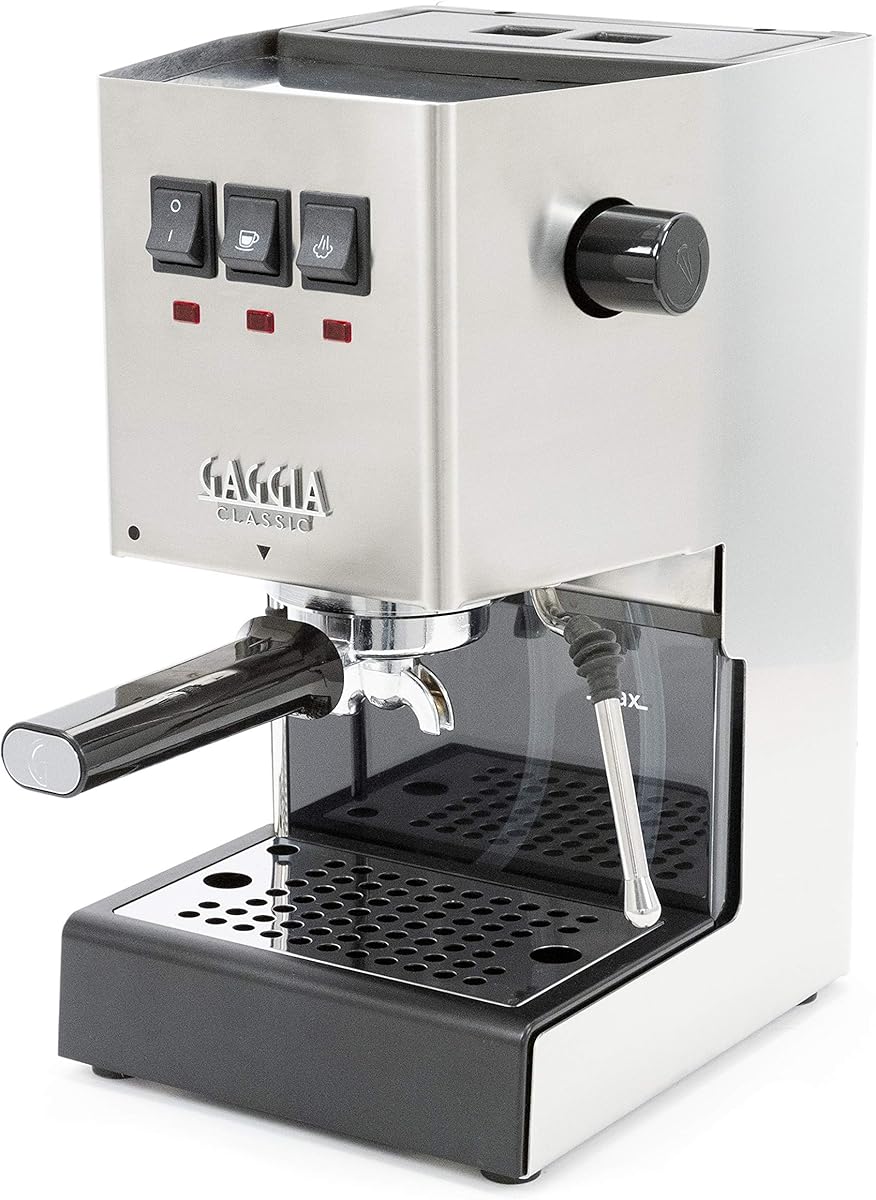
Gaggia E24 (RI9380/46)
58 mm portafilter, a three-way solenoid valve, two commercial baskets and a pressurised one in the box, and 9 bar quoted at the puck rather than at the pump. It will ask more of you than anything else here.
$449.00 · 3,169 reviews
What it gives up
No grinder. The E24 grinds nothing, and a machine this manual is unusually punished by a grinder that cannot move in small increments. The arithmetic below is the real price of entry.
No PID and no temperature control. Nothing on the listing offers a temperature setting, and with the heating system unnamed there is no way to reason about how stable it is. This is the honest limit of what a listing can tell you.
1200 watts, the lowest here. Combined with a heating system the manufacturer will not name, plan on waiting for it rather than starting it and walking up to it.
A manual steam wand and nothing else. No automatic texturing, no temperature probe, no stop. The listing calls it a commercial steam wand and lists latte art among the recommended uses, which is a fair description of both the capability and the effort.
Leaks are a named pattern, not an outlier. Covered above. It belongs in this list too.
What it actually costs to start
Worked example
The E24 plus a grinder, against the machine that has one inside
Snapshot prices from 28 August 2026. The Smart Grinder Pro is used because it is the only grinder this site covers — not because E24 owners buy it. We have no evidence about what they pair it with and will not invent any.
- 1E24 (RI9380/46)58 mm portafilter, three baskets, tamper and scoop in the box. No grinder.$449.00
- 2Smart Grinder Pro (BCG820)Conical burrs and 60 settings. The adjustment resolution is the point, not the brand.$199.95
- 3The pairEverything needed to pull and repeat a shot.$648.95
- 4Barista Express (BES870XL)Grinder built in, 54 mm fittings, one box.$699.95
- 5What the Barista Express costs above that pairClose enough that price is not the deciding factor between them. Fittings and floor space are.$51.00
These two land within about fifty dollars of each other, which reframes the decision entirely. It is not cheap-versus-expensive. It is two boxes with commercial fittings and a grinder you can upgrade independently, against one box with 54 mm fittings and a grinder you cannot remove.
Cheaper burr grinders than this one exist. We have not covered any, so we will not name one. A blade grinder is not a cheaper version of this purchase — it cannot produce a consistent particle size, which is the single variable this entire machine asks you to control.
Who should buy something else
If you want espresso on a weekday morning without thinking about it, buy the Bambino. It heats in seconds, it is the narrowest Breville we cover, and it does not ask you to own opinions about baskets. It also has no grinder, so the same arithmetic applies — we have set the two out side by side on exactly this question, because commercial fittings against fast, small and simple is the real choice and neither answer is wrong.
If you want one box and no second purchase, that is the Barista Express (BES870XL). It has the grinder inside it, it costs about what the E24 pair costs, and it has the largest review corpus of anything on this site by a very long way. You give up the 58 mm accessory world to get it, and most people never miss it. The built-in-versus-separate grinder decision is worth reading before you commit either way.
If you are not sure you will still be doing this in a year, do not start here. The CASABREWS CM5418 is the cheapest honest way to find out whether you enjoy the process, and finding that out on a 51 mm machine costs you nothing except the accessories you were never going to buy. Come back to the E24 when the answer is yes.
If the 58 mm fitting is what brought you here, this is the one. The only other machine on this site with it costs $2300.95 and rates 3.4 stars across 597 reviews — the lowest rating in the entire set. That is not a near-miss alternative. It is a reason the E24 has no real competition at this end of the market.
Where this leaves you
Commercial fittings, and a machine that does nothing for you
- 58 mm commercial portafilter — the only machine here under $2,000 with one, and the reason the whole third-party accessory market fits it.
- Advertises 9 bar in the same spec field where the CM5418 advertises 20. 9 is the pressure espresso is actually brewed at.
- 4.4★ across 3,169 Amazon reviews, with espresso quality at 12% negative mentions.
- Leakage runs 94% negative across 62 mentions and the listing states no warranty length. Buy where returns are easy.
- No grinder: with the only grinder this site covers, the pair is $648.95.
Price, rating and review counts are Amazon's, read 28 August 2026, and change without notice. We do not test machines and do not claim to.
How this page was put together, and what our method can and cannot prove, is set out in our editorial policy.